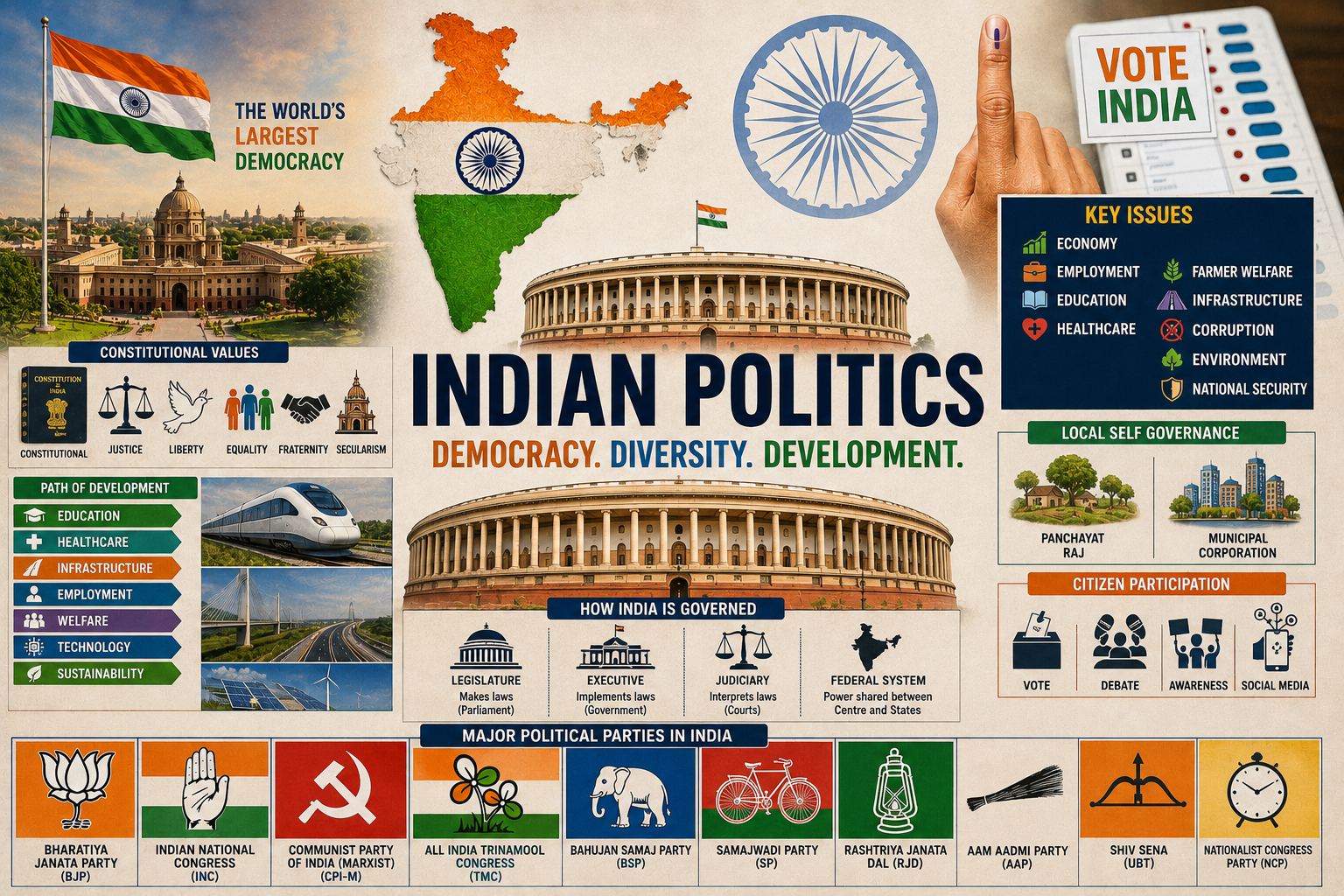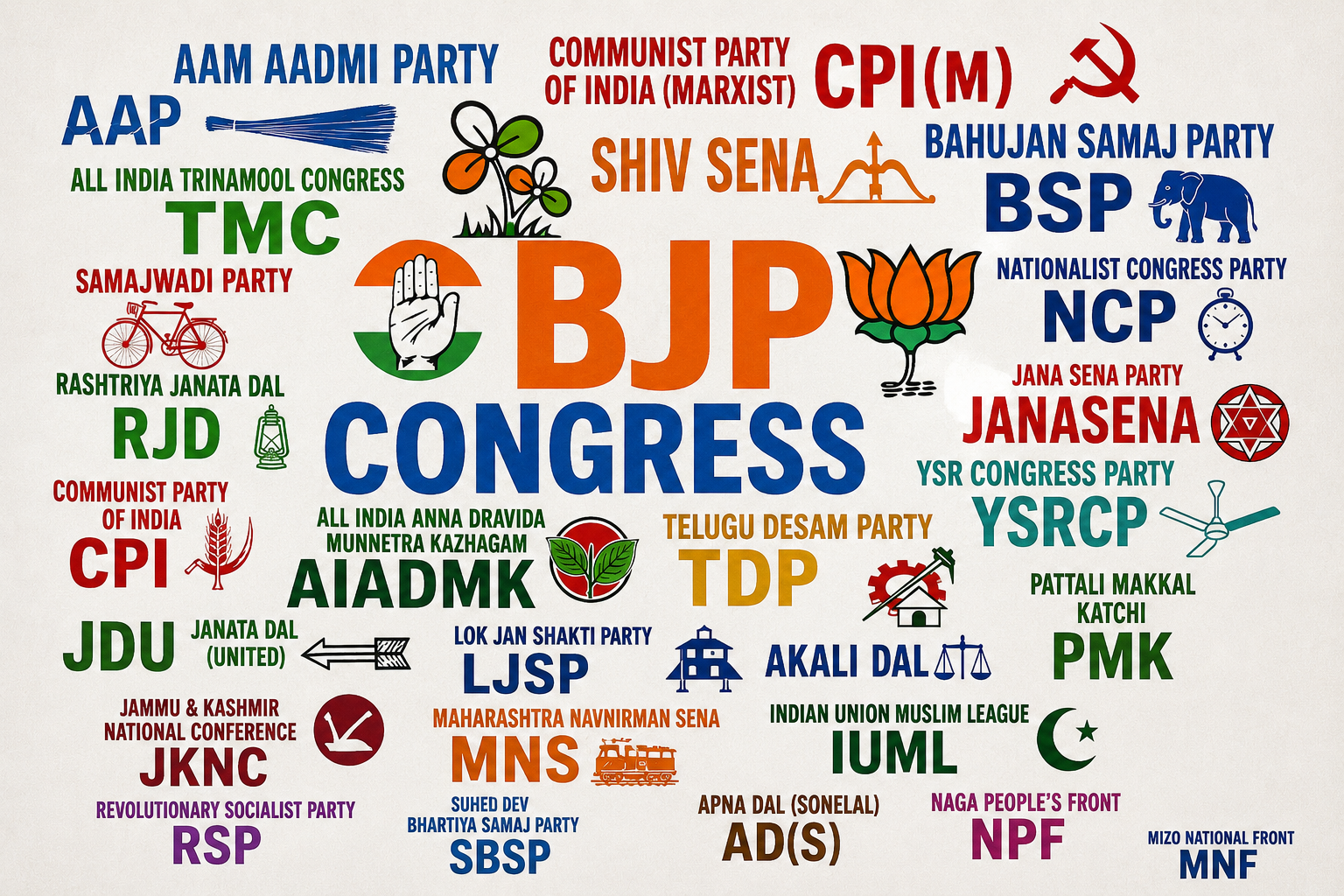

Image: Wikimedia
BNN Summary
India's political landscape is undergoing a significant transformation, marked by the steady decline of once-dominant regional parties and the strategic expansion of the Bharatiya Janata Party (BJP). While regional outfits historically held considerable sway, recent elections have seen many decimated, yielding space to national parties. This shift is reshaping state and national politics, even as the BJP itself had to form a coalition government after the 2024 Lok Sabha elections.
In-Depth Analysis
India's political landscape is witnessing a profound realignment, characterized by the weakening of powerful regional parties and the Bharatiya Janata Party's (BJP) relentless expansion across the nation. For decades, regional outfits were integral to India's federal structure, often acting as kingmakers in national coalitions and serving as formidable bulwarks against pan-India parties like the Congress. However, in recent years, this dynamic has shifted dramatically, with many regional forces struggling to maintain their ground against the BJP's growing might.
Historically, the era between 1989 and 2014, often dubbed the 'coalition era,' saw regional parties flourish, becoming critical 'veto players' at the Centre. Their strength was rooted in caste-based coalitions, state-specific issues, and charismatic leadership, which often outmaneuvered national parties in their respective strongholds. However, the BJP, under Prime Minister Narendra Modi, has actively worked to reverse this trend, aiming for a more unitary approach to politics and promoting a 'one nation, one culture' ideology.
The BJP's strategy has involved a multifaceted approach to expand its footprint. It has successfully formed alliances with regional parties, often dominating these coalitions over time and eventually absorbing their support base, as seen in states like Assam. The party has also leveraged national narratives, leadership dynamics, and extensive use of social media to mobilize support more effectively than many regional counterparts. The result has been a significant decline in the influence of numerous regional powerhouses, with the BJP expanding its hold across many of India's states.
One of the most striking recent examples of this trend is the dramatic collapse of the Trinamool Congress (TMC) in West Bengal. Following a significant electoral defeat in May, where the BJP secured a massive 208 seats and ended the TMC's 15-year rule, the party has experienced severe fragmentation. On June 14, 20 of its 28 Lok Sabha MPs reportedly rebelled, seeking to merge with another party to support the National Democratic Alliance (NDA), the BJP-led coalition. Additionally, several Rajya Sabha members resigned, and reports indicate that dozens of MLAs and over a hundred municipal councillors have also left the TMC, signaling a widespread disintegration across all levels. This crisis has ignited debate over whether the party's model, built more around cult leadership and welfare populism than a coherent ideological foundation, made it inherently vulnerable once it lost power.
Similar stories of decline and fragmentation have unfolded in other states. In Maharashtra, the once-dominant Shiv Sena (Uddhav Thackeray faction) and Sharad Pawar's Nationalist Congress Party (NCP) have been significantly weakened. The Shiv Sena experienced a major rebellion in 2022, leading to a split and the marginalization of the Uddhav faction after the BJP and its allies secured a decisive victory in the subsequent Assembly elections. Similarly, the NCP split in July 2023, with Ajit Pawar leading a faction that joined the BJP, diminishing Sharad Pawar's long-standing influence. In Odisha, Naveen Patnaik's Biju Janata Dal (BJD), which had ruled the state for an extended period, lost power to the BJP in the 2024 Assembly elections, finding itself out of government for the first time. The Asom Gana Parishad (AGP) in Assam, once a strong voice for regional aspirations, has also seen its influence wane as the BJP rose to dominance in the Northeast.
The factors contributing to the weakening of regional parties are multifaceted. The BJP's emphasis on a pan-Hindu political identity and the nationalization of elections have reduced the leverage regional leaders once enjoyed. Regional parties are increasingly vulnerable to internal splits, defections, and absorption into BJP-led coalitions. Furthermore, many regional parties, often centered around charismatic leaders, struggle to survive electoral setbacks without a strong ideological framework to bind their cadres. Allegations of the use of investigative agencies against opposition leaders and gubernatorial interventions in opposition-ruled states have also raised concerns about democratic backsliding, further challenging regional parties.
Despite the overarching trend of regional party decline, the 2024 Lok Sabha elections presented a nuanced picture. While the BJP emerged as the single largest party, it unexpectedly fell short of securing an absolute majority on its own, winning 240 seats, 32 short of the required 272. This outcome forced Prime Minister Modi to form a coalition government, relying on partners like the Telugu Desam Party (TDP) and the Janata Dal (United) (JD(U)). The results indicated that in key states like Uttar Pradesh, Maharashtra, and West Bengal, the opposition's INDIA bloc, comprising several regional parties, achieved significant successes by effectively addressing local issues and consolidating anti-incumbency sentiment. This demonstrated that while the BJP's influence is extensive, regional forces can still pose a formidable challenge, particularly when they unite and focus on local concerns. However, the long-term structural shift towards weakening regional players and BJP's continued strategic expansion remains a dominant narrative in Indian politics.
How do you feel about this story?
Discussion
No comments yet. Be the first to share your thoughts.
Join the discussion
Sign in to share your thoughts on this story.